
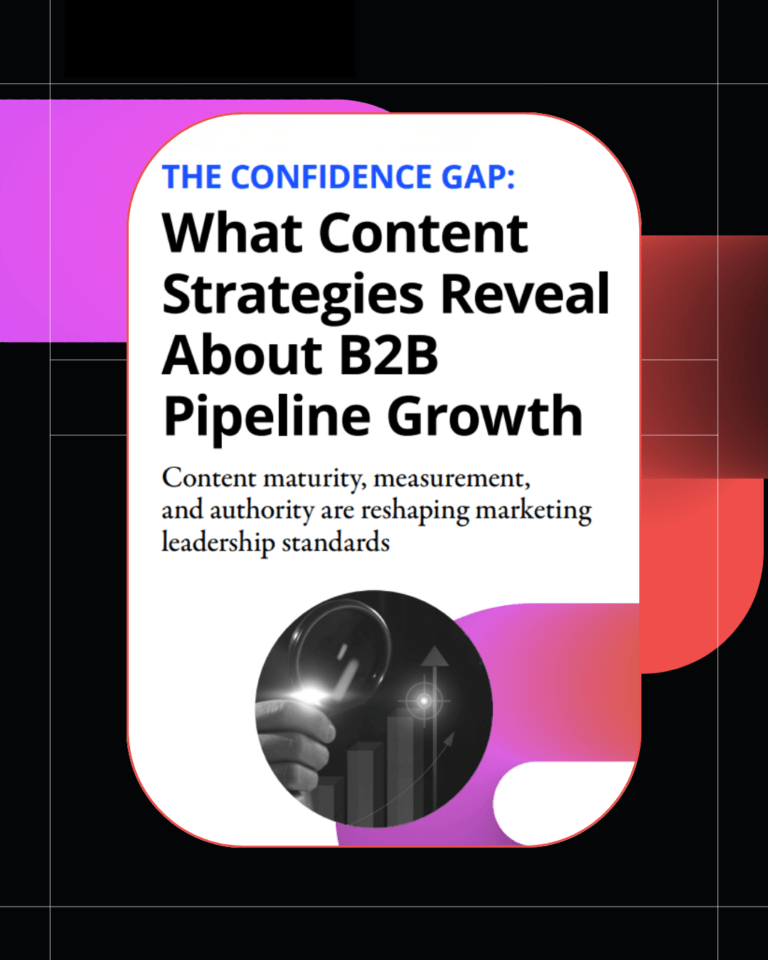

Study of 555 marketing leaders finds most teams believe their content operations are mature, but fewer than 1 in 5 track pipeline contribution as a key performance metric
March 17, 2026 — Despite widespread confidence in content maturity, B2B marketing organizations are struggling to connect activity to predictable pipeline outcomes, according to new research from Pipeline360, a leading B2B demand generation company.
The 2026 State of B2B Marketing Content report, based on a survey of 555 B2B marketing professionals across six countries, identifies a growing “confidence gap” — a disconnect between how marketing teams perceive their capabilities and their ability to explain how content drives buying group movement, pipeline progression, and revenue.
While 54% of respondents describe their content strategy as advanced, the research reveals significant friction beneath that confidence. Nearly half (48.3%) say attribution gaps moderately limit their ability to optimize content. Three-quarters report that poor data quality negatively impacts campaign performance on a regular basis. And the most common KPIs used to measure content performance — page views (40.4%), social media followers (39.3%), and click-through rates (38.7%) — remain focused on visibility rather than pipeline outcomes. Pipeline contribution is tracked by just 19.1% of respondents.
“A lot of teams mistake motion for maturity,” said Matt Hummel, Chief Marketing Officer of Pipeline360. “They are producing more content, using more tools, and moving faster. That does not necessarily mean they have a better understanding of what content is actually responsible for.”
AI Adoption Widespread, But Weighted Toward Production
The research also found that while 93.7% of B2B marketers are using AI in their content operations, adoption remains concentrated in production-oriented tasks. Content creation (43.8%), performance analysis (36.0%), and editing (35.7%) lead current use cases. More advanced applications — including account-level targeting (29.4%), personalization (29.0%), and lead nurturing optimization (25.2%) — are less common.
At the same time, the rise of low-quality content was cited as the top concern related to AI adoption (59.2%), highlighting a tension between speed and precision.
“AI amplifies whatever operating model is already in place,” Hummel said. “Without clear accountability, trusted data, and defined outcomes, it scales noise. With them, it becomes a force multiplier for clarity and performance.”
Data Quality Emerges as Leading Indicator of Pipeline Performance
The study found a strong relationship between data confidence and pipeline results. Top pipeline performers are significantly more likely to express very high confidence in the quality of their marketing data than average or low performers. Organizations with high data confidence are also more likely to expect future budget growth.
Yet 75.6% of respondents acknowledge that poor data quality negatively affects campaign performance occasionally or frequently — suggesting that data readiness remains a critical gap for most marketing organizations.
What High-Performing Teams Do Differently
The research identified several patterns among more confident, higher-performing organizations. These teams are more likely to define content accountability in terms of pipeline progression and buying group engagement rather than activity metrics. They invest more heavily in authority-building content formats — including research-driven content, long-form analysis, and interactive experiences. And they prioritize a narrower, more trusted set of measurement signals over comprehensive reporting.
“These are not tactical differences,” Hummel said. “They are leadership choices. Content just happens to be where the consequences show up first.”
About the Research
The 2026 State of B2B Marketing Content report was commissioned by Pipeline360 and fielded by Centiment. Analysis, writing, editing, and design were performed by The Expert Network. Respondents represented a broad mix of marketing and revenue roles across the United States, United Kingdom, Germany, France, Australia, and Singapore, spanning company sizes from under $10 million to over $1 billion in annual revenue.
The full report is available for download at https://www.pipeline-360.com/resources/reports/the-2026-state-of-b2b-marketing-content.